You murdered my tender one!
A debate between man and death
in the corners of a night.
ACTION
Based on the first German prose text “Ackermann aus Böhmen” by Johannes von Saaz – a Bohemian lawyer.
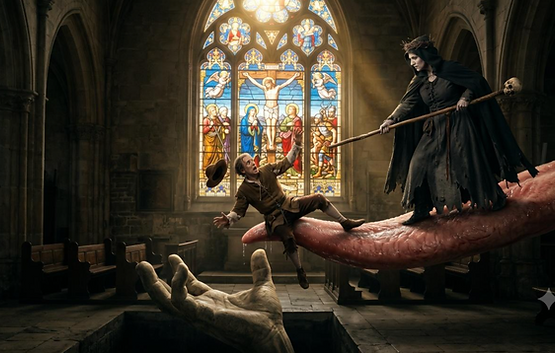
Imagine losing the person you love most – and in the dead of night, in the empty nave of the church, the cause of your pain appears before you in person.
The scholar "scribe" sends his children home to remain alone in the somber silence of a church. Tormented by the brutal finality of losing his beloved Margaretha, he hurls his wildest curses at death. And death answers. But from the shadows emerges not a skeletal Grim Reaper, but Lady Death herself.
Between the pews, a rhetorically brilliant, merciless duel of life and death erupts. It is a trial of the soul, in which accuser and defendant grapple with the meaning of love, the price of remembrance, and the justification of mortality. The escalation of this philosophical clash inevitably pushes both adversaries to their limits—until an overwhelmingly radiant, divine light compels them to recognize their own insignificance in the face of creation.
Death is not a silent, cruel murderer. She is a shrewd, adaptable adversary who systematically disarms Ackermann. Her profound arguments force Ackermann to the realization:
Those who unconditionally affirm love have already silently accepted the pain of loss.
While the dispute between the two protagonists forms the emotional core, the chorus elevates the drama to a universal dimension. The chorus, which at times rises surprisingly directly from the audience, is far more than an ancient embellishment – it is the critical voice of modern consciousness. In detailed, poetic interludes, it dissects humanity's greatest dilemma: memory. The chorus makes it tangible that the true torment is not death itself, but rather humanity's inability to forget.
Furthermore, the choir draws a connection to our present day. In powerful words, it exposes today's technology-obsessed humanity, which has become alienated from its own creative nature through machines. It depicts a society that fancies itself hubris ("We forgot the 'how' – and wanted to be God"), but ultimately, driven by a breathless fear of mortality, leads an artificially prolonged life and dies "in hiding."